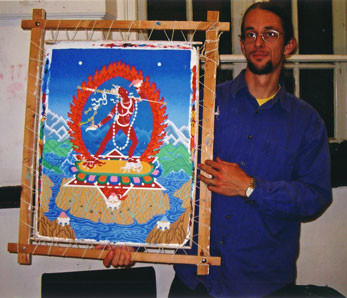
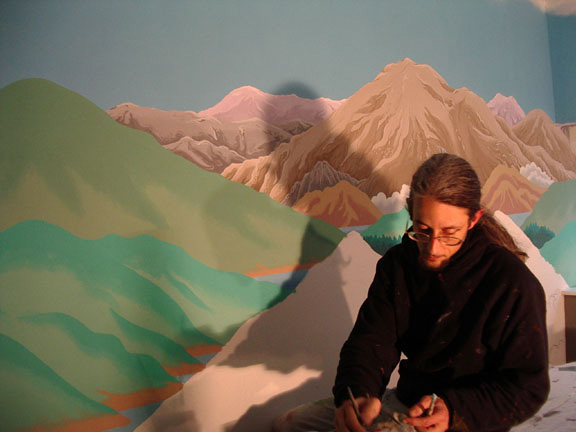
Peter "Zotec" Newman
has studied the art form of Thangka painting since 1999 with the accomplished
and internationally renowned painter and teacher Andy Weber. Andy has maintained the accuracy and
skill of the discipline in order to teach others throughout the western world; information about his classes
can be found at www.andyweberstudios.com
An Introduction to Tibetan Thangka Painting
by Peter "Zotec" Newman, Cumbria, England ©2006
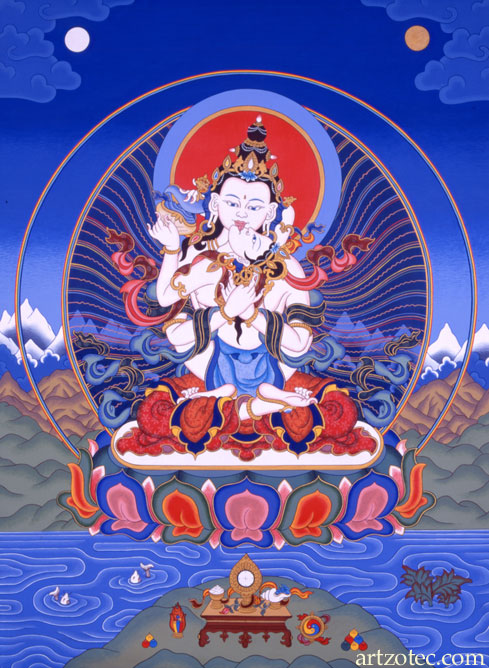
"These images originated from visions of living deities which were seen by mystics deep in meditation and during their
daily lives in the remotest wild places of Tibet. The tradition of art in Tibet associated with Esoteric Buddhism began
around the 7th century A.D. in the form of portraiture painted on monks' outer garments, and idea introduced from India,
and has been influenced by many surrounding cultures especially the Chinese silk painting of the Han Dynasty. The methods
and traditions of Thangka painting have been passed from teacher to student for many centuries. There was a noticeable
renaissance in both style and skill between the 13th and15th centuries A.D. with the influx of Nepalese artists into Tibet and
in particular due to the work of the artist Menla Dondrub, whose style and measurements are still widely used today.
There is a particularly strong influence from Indian royal portrait painting - this is clearly shown in the painting of royal dress
and jewels on many of the deities in an attempt to portray their status.
"In Tibet there have been many artists willing to devote their lives to the development and refinement of the techniques
involved in Thangka painting, from the use of natural mineral pigments and fine gold powder to the efficient methods of
preparing the canvas as well as the fine silk brocade which is used to frame the paintings. The art form has become very
widespread in recent times and now includes the use of new materials and colours developed in the West.
"There are three recognised paths of buddhism, which have their associated practices; these are the Hinayana, Mahayana
and Vajrayana, meaning the "small", "great", and "lightning-bolt" paths respectively. Practitioners of the Vajrayana path use
the painted images to help them to visualise in meditation the perfection of the physical world through association with
aspects of the enlightened self, which are represented by the deities of Tantric buddhism. Although used for such religious
practice, the images have seen a renewed popularity and their inherent harmony and balanced form convey a sense of
meaning directly to the centre of one's being. The mandala paintings are also used in ritual settings for divination and the
"Wheel of Life" painting, which is probably the oldest image in Buddhism, has been widely used as a teaching aid for Dharma
students because it contains symbolism and scenes that show all of the fundamental teachings of the Buddha. The wrathful
deities are important in that they represent protection for the practitioner and encourage the willingness to face all of the
darkest experiences of human existence in order to develop true strength of mind and spiritual power".
|